 Innotex Group


How to Choose Custom Printed Bags for Global Sourcing
Choosing Custom Printed Bags for global sourcing requires more than selecting attractive colors and a low unit price. The bag must suit the product, destination, customer expectations, and supply chain conditions. A paper shopping bag may look elegant in a showroom, yet fail in humid storage. A woven bag may survive repeated use, but its print quality can vary across large production runs. These details matter.
Reliable sourcing begins with clear specifications. Define dimensions, material, thickness, handle strength, printing method, color references, and packaging requirements. Ask suppliers for physical samples, production photos, factory information, and recent quality records. A pre-production sample can reveal ink bleeding, weak seams, inaccurate colors, or uncomfortable handles. Small defects become expensive when thousands of bags arrive.
Check the supplier’s testing process. Useful checks include weight capacity, abrasion resistance, moisture exposure, odor, and print adhesion. Confirm that inks, coatings, and materials meet the destination market’s applicable standards. Requirements may differ between regions, so written documentation is essential. Do not rely only on a polished catalog.
Communication can fail.
Use measurable language. “Premium quality” is not enough. Specify acceptable color variation, tolerances, carton markings, and inspection points. Independent inspections can provide additional confidence before shipment. Still, no sourcing plan is perfect. A supplier may pass one inspection and struggle during peak production. A backup timeline, realistic delivery buffer, and documented corrective process can reduce that risk. Careful evaluation creates bags that represent your brand consistently, from the first carton to the final customer interaction.
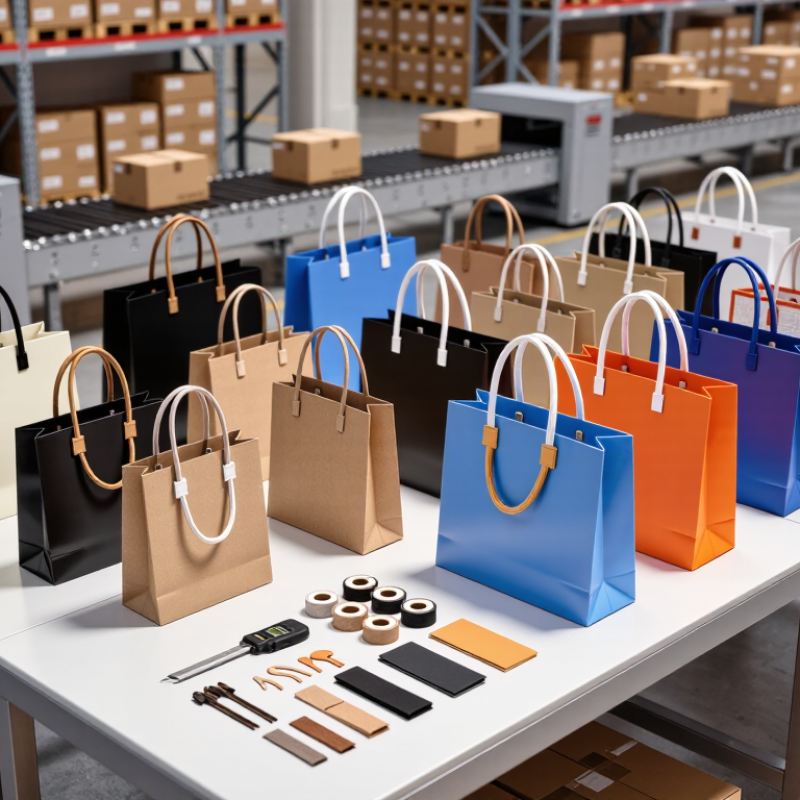
Define Your Custom Printed Bag Requirements and Sourcing Goals
Before requesting quotations, define what the bag must achieve. Record its dimensions, carrying weight, closure style, handle length, material, print colors, and surface finish. A grocery bag needs different strength than a garment pouch. Specify drop-test expectations and moisture exposure. Do not rely on attractive samples alone.
Your sourcing goal should include target cost, order quantity, delivery window, and destination market. Ask suppliers to separate material, printing, tooling, packing, and freight costs. This makes price comparisons more reliable. The OECD’s Global Plastics Outlook reports that packaging creates about 40% of global plastic waste. Therefore, include recycled content, recyclability, or reduced material use in the brief. UNEP’s 2023 Turning off the Tap report also identifies packaging redesign as a major pollution-reduction opportunity. These targets may increase initial costs. They can still reduce waste and improve long-term purchasing decisions.
Tips: Prepare a one-page specification sheet with a reference sample, color standard, carton dimensions, and acceptable defect limits. Request a pre-production sample before mass production. Check print rub resistance with a simple dry-cloth test. Confirm factory capacity during peak seasons. A lower unit price can mislead. I have seen unclear specifications create expensive rework, especially when color expectations remain subjective. Leave room for revision; the first brief is rarely perfect.
How to Choose Custom Printed Bags for Global Sourcing
Define Your Custom Printed Bag Requirements and Sourcing Goals
| Bag Format | Typical Application | Recommended Material | Typical Size Range | Printing Requirement | Indicative Order Quantity | Indicative Production Lead Time | Key Sourcing Check |
|---|---|---|---|---|---|---|---|
| Cotton Tote Bag | Retail, events, reusable promotional packaging | Natural or dyed cotton, approximately 120–300 g/m² | 30 × 35 cm to 45 × 50 cm | One- to four-color screen print; water-based or pigment ink options | 500–5,000 pieces | 25–45 days after artwork approval | Check fabric weight, shrinkage after washing, handle stitching, and print registration |
| Nonwoven PP Bag | Supermarkets, trade fairs, short-term promotional campaigns | Polypropylene nonwoven fabric, approximately 70–120 g/m² | 25 × 30 cm to 45 × 40 cm | Flexographic or screen printing; large-area artwork is generally practical | 1,000–10,000 pieces | 20–35 days after artwork approval | Confirm denier or fabric weight, seam strength, odor, and recyclability requirements |
| Kraft Paper Bag | Boutiques, food service, takeaway retail packaging | Recycled or virgin kraft paper, approximately 80–120 g/m² | 18 × 8 × 24 cm to 32 × 12 × 42 cm | Offset, flexographic, or spot-color printing; matte finishes are common | 1,000–20,000 pieces | 20–40 days after artwork approval | Verify paper basis weight, moisture resistance, handle attachment, and bottom-load performance |
| LDPE or HDPE Mailer Bag | E-commerce shipping, apparel, lightweight non-fragile goods | Polyethylene film, approximately 50–100 microns | 25 × 35 cm to 40 × 55 cm plus flap | Rotogravure or flexographic printing; opaque white layers may be needed for color accuracy | 5,000–50,000 pieces | 25–45 days after artwork approval | Test seal strength, puncture resistance, tear behavior, adhesive closure, and applicable plastic rules |
| Recycled PET Bag | Durable reusable shopping or promotional programs | Recycled polyester fabric, approximately 120–250 g/m² | 30 × 35 cm to 45 × 50 cm | Screen, heat-transfer, or dye-sublimation printing depending on fabric construction | 500–5,000 pieces | 30–50 days after artwork approval | Request recycled-content evidence, colorfastness results, and a statement on chemical compliance |
Custom Printed Bag Requirement Checklist
| Requirement Dimension | Recommended Planning Input | Suggested Target or Tolerance | Validation Method | Sourcing Goal |
|---|---|---|---|---|
| Finished Dimensions | Bag width, height, gusset, handle drop, and closure type | Define dimensions in centimeters; allow approximately ±5 mm for flexible bags | Measure approved samples and conduct pre-shipment inspection | Consistent fit for products and retail displays |
| Load Capacity | Expected product weight and carrying duration | Specify a test load, such as 5 kg or 10 kg, and a minimum hold time | Static load, drop, handle-pull, and seam-strength tests | Reduce complaints caused by handle or bottom failure |
| Artwork and Color | Logo placement, print area, color references, and file format | Provide vector artwork; approve a physical pre-production sample | Compare sample with approved artwork under consistent lighting | Protect visual consistency across repeat orders |
| Material and Sustainability | Virgin, recycled, organic, recyclable, compostable, or reusable specification | State the required recycled content or certification evidence before quotation | Review supplier documents, material declarations, and laboratory reports | Meet sustainability claims without unsupported environmental statements |
| Regulatory Compliance | Destination countries, product-contact use, labeling, and packaging restrictions | Confirm requirements for each destination market before production | Obtain relevant declarations and test reports from the supplier | Avoid customs delays, recalls, and non-compliant claims |
| Order Quantity and Reorder Plan | Initial order volume, quarterly demand, and acceptable inventory level | Request pricing at three quantities, such as 1,000, 5,000, and 10,000 units | Compare unit cost, tooling, setup, storage, and freight at each level | Balance unit price against inventory and cash-flow risk |
| Landed Cost | Product price, printing, packaging, freight, duties, inspection, and inland delivery | Set a maximum landed cost per bag before supplier comparison | Use the same Incoterm, destination, currency, and quantity for all quotations | Compare suppliers using total delivered cost rather than unit price alone |
| Delivery and Risk Control | Required arrival date, shipping route, backup plan, and inspection stage | Allow time for sampling, production, inspection, and international transit | Use milestone dates and approve a written quality standard | Improve schedule reliability and reduce late-delivery exposure |
Note: Quantity, cost, and lead-time figures are indicative planning benchmarks. Actual results vary by material, dimensions, printing method, order volume, season, destination, and shipping conditions.
Related Posts
-

How to Choose the Best Packaging Bags for Global Shipping?
-
Emerging Trends in Eco-Friendly Print Bags: Insights from the 2023 Packaging Market Report
-
2026 Best Personalised Packaging Bags for Global Buyers
-

Unlocking Quality: Your Ultimate Guide to Finding the Best Custom Box Suppliers
-
What is Custom Sample Bags and How Can They Benefit Your Business?
-
How to Choose the Best Packaging Printer for Your Business?