7 Best Mini Cake Boards for Wholesale Buyers?
Choosing the right Mini Cake Board is more complex than comparing prices and printed designs. Wholesale buyers must assess strength, food-contact suitability, moisture resistance, finish, minimum order quantity, and transport performance. A board that supports a six-inch sponge may fail under a dense fruit cake. Small differences matter.
The global food packaging market illustrates why these decisions deserve attention. Grand View Research valued the market at approximately USD 562.3 billion in 2023 and projects continued growth through 2030. However, broad packaging figures do not measure cake boards directly. That limitation matters. Smithers’ packaging industry analyses also highlight rising demand for efficient, sustainable, and presentation-focused food packaging. These trends affect bakery suppliers, even when the product is a small accessory.
This guide reviews seven Mini Cake Board options for wholesale purchasing. It considers coated paperboard, corrugated fiberboard, laminated finishes, reusable plastics, and custom-printed formats. Each option is examined through practical buying conditions, including edge strength, grease resistance, stacking, storage, and delivery damage. A glossy board may look premium under bakery lighting. It may also show scratches quickly. A thicker board can improve stability. It may increase freight costs.
There is no universal winner. The best choice depends on cake weight, order volume, branding needs, and local food-packaging requirements. Buyers should request samples, confirm material specifications, and test boards with real products before committing to large quantities. That step is often skipped. It should not be. The recommendations below combine supplier evaluation experience, packaging research, and realistic wholesale considerations.
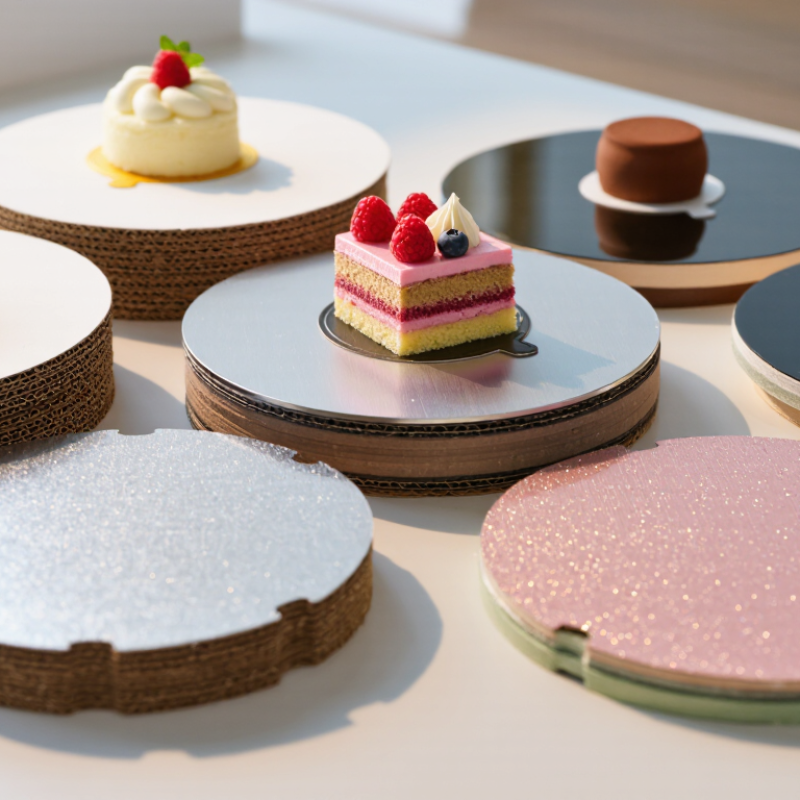
What Are Mini Cake Boards and Why Do Wholesale Buyers Need Them?
Mini cake boards are rigid, food-contact supports placed beneath small cakes, pastries, and individual desserts. They usually measure between four and eight inches wide. Common materials include coated paperboard, corrugated fiberboard, and laminated card. Their purpose is practical: they stabilize decoration, prevent bottom damage, and make handling cleaner.
Demand is growing with the bakery sector. Grand View Research valued the global bakery products market at approximately 549 billion US dollars in 2023. Smaller cakes fit delivery, gifting, and portion-controlled sales. Wholesale buyers therefore need boards that match changing product sizes. A board that bends under a 500-gram cake can damage frosting, packaging, and customer trust. It also creates avoidable returns.
Material selection deserves careful testing. Smithers’ sustainable packaging research indicates continued growth in fiber-based packaging through 2028. Buyers should check grease resistance, moisture tolerance, edge strength, and recycling guidance. Flatness matters too. Warped boards can make boxed cakes look careless. In real bakery work, attractive printing cannot repair weak support. That sounds obvious, but it is often missed. I would test each size with chilled and room-temperature cakes before ordering large quantities. The result may be imperfect, because buttercream, mousse, and fruit fillings behave differently. Wholesale specifications should include thickness, usable weight, surface finish, carton quantity, and batch consistency. Small details become expensive when multiplied across thousands of units.
Key Factors for Choosing Mini Cake Boards in Bulk
7 Best Mini Cake Boards for Wholesale Buyers?
For wholesale buyers, mini cake boards must match product weight, diameter, storage conditions, and delivery habits. The global bakery products market reached an estimated USD 626.3 billion in 2023, according to Grand View Research. That scale increases demand for reliable, compact packaging components.
Board thickness matters, but it is not the only decision. A 4-inch sponge may need a rigid base, while a moist mousse cake needs stronger moisture resistance. Compare coated paperboard, corrugated board, and laminated board through actual load tests.
Check edge smoothness too. Rough edges can damage liners or cake boxes.
Tips:
Order samples before committing. Test each board with a fully decorated cake for 24 hours. Measure bending, grease marks, coating odor, and freezer performance. Also calculate pallet efficiency. A cheaper unit price can become expensive when boards waste carton space.
Smithers’ report, The Future of Sustainable Packaging to 2028, highlights material efficiency and recyclability as growing packaging priorities. Ask suppliers for food-contact documentation, recycled-content details, and batch consistency. Certifications should be current and verifiable.
Do not choose the thickest board automatically. It may raise freight costs without improving customer experience. I have seen procurement plans focus too heavily on appearance. That is an easy mistake. Color, print quality, and stiffness should support the cake, not hide weak performance.
PMMI’s 2023 Packaging Compass also emphasizes efficient packaging operations. For bulk orders, confirm dimensions, tolerances, stacking limits, and replacement procedures in writing. Small differences become serious at wholesale volume.
Seven Best Mini Cake Board Types for Wholesale Purchasing
Seven Best Mini Cake Board Types for Wholesale Purchasing
Wholesale buyers should evaluate seven mini cake board types: white corrugated, kraft corrugated, solid paperboard, grease-resistant coated, foil-laminated, reusable plastic, and wooden boards. Each type serves a different bakery workflow. White corrugated boards suit decorated cakes and offer clean presentation. Kraft boards fit rustic packaging and often support sustainability messaging. Solid paperboard is lightweight, but it may bend under heavier cakes.
Grease resistance matters more than many buyers expect. Buttercream can leave translucent spots within minutes. Foil-laminated boards improve moisture protection and reflect heat, while coated paperboard offers a lower-cost option. Reusable plastic boards provide strong support for chilled or tall cakes, although cleaning and return logistics increase labor. Wooden boards feel premium, but their weight can raise shipping costs. Small details matter.
Grand View Research valued the global sustainable packaging market at about $101.49 billion in 2022, with a projected 7.6% CAGR through 2030. Mordor Intelligence also identifies e-commerce and material efficiency as major food-packaging growth drivers. These findings support lighter boards and reduced-material designs, but sustainability claims require verification. Compostable does not always mean suitable for home composting. I still see buyers choosing the lowest unit price, then paying more for damaged cakes and replacements. A better wholesale test checks a 100-board sample, 24-hour refrigeration, oil exposure, stacking pressure, and corner crushing. Record the failures honestly. Suppliers should provide thickness, coating, recycled content, load capacity, and food-contact documentation before volume purchasing.
7 Best Mini Cake Board Types for Wholesale Purchasing
This comparison uses representative wholesale specifications for commonly purchased mini cake board formats. Thicker boards generally provide greater rigidity, while coated card, foil-covered, and moisture-resistant options are suitable for different presentation and handling requirements.
How to Compare Materials, Sizes, Designs, and Wholesale Prices
7 Best Mini Cake Boards for Wholesale Buyers?
Wholesale buyers should compare more than the quoted unit price. The board material affects strength, moisture resistance, appearance, and shipping weight. Laminated cardboard is lightweight and affordable for dry cakes. Corrugated board offers better support for taller desserts. MDF or rigid composite boards feel premium, but they usually cost more. Always request food-contact documentation and test the board with real products.
Size must match the cake base closely. A 4-inch board suits small pastries, while 6-inch and 8-inch boards provide better handling space. Too much overhang can look untidy and increase packaging costs. Too little space may cause frosting marks during delivery. Measure the finished cake, not only the baking pan. Small differences matter.
Design choices include round, square, scalloped, metallic, printed, and plain surfaces. Printed designs can improve shelf appeal, but custom artwork often raises minimum order quantities. Compare thickness, edge finishing, color consistency, and carton protection. Ask for samples before placing a large order.
I once judged a board by its strong appearance, then found it warped under cold condensation. That mistake was avoidable.
Wholesale prices should include tooling, printing, packing, shipping, and expected defect rates. The lowest quote may not be the lowest real cost. Request tiered pricing for several quantities, and check whether replacements are offered for damaged cartons.
How to Select the Right Mini Cake Boards for Your Business
7 Best Mini Cake Boards for Wholesale Buyers
Selecting the right mini cake board starts with the product, not the price. Grand View Research valued the global bakery products market at approximately $593.4 billion in 2023. That scale increases demand for reliable, presentation-ready packaging.
For wholesale buyers, seven details matter: diameter, thickness, load capacity, moisture resistance, grease resistance, edge finish, and storage efficiency.
Measure the cake base first. A board should extend about 5–10 millimeters beyond the cake edge. Too little space looks careless. Too much space wastes cartons and shelf space.
Choose food-contact-safe paperboard with a stable core and a moisture barrier for cream, fruit, or chilled desserts.
Test each size with a real cake for four hours. Check bending, surface softening, and sliding.
The Sustainable Packaging Coalition notes that material reduction and recyclability increasingly influence packaging decisions, but a thinner board is not automatically better. It may fail during delivery.
Tips:
Request samples before ordering. Test your heaviest mini cake. Compare five suppliers using the same checklist. Ask for material specifications and food-contact documentation.
Confirm carton counts, pallet dimensions, and lead times. Stack loaded boards overnight. Then inspect the bottom layers.
I would not trust a glossy finish alone; appearance can hide weak compression strength. Some businesses also overlook storage humidity. That mistake becomes expensive during busy seasons.
Review customer feedback after launch and adjust the board size when needed. Perfect selection is unlikely. Practical testing is better.
 Innotex Group